August 26, 2022
<aside> <img src="/icons/reorder_blue.svg" alt="/icons/reorder_blue.svg" width="40px" /> Navigation
</aside>
Table Of Contents:
I normally get ideas and insights from people X (formerly Twitter). I have added the people with the most relevant content to my Twitter lists.
A. Easy Mode - Access lists to follow
B. Detailed Mode - Direct Access
That’s like my library of the most important people I follow, who conduct relevant and deep research. Here you can get ideas from people running some of the biggest financial institutions, some of whom have over 30 years of experience in trading and investment.
This is mentorship 101 without knowing the individual. Most are based in the US and Europe.
This is very important to ease the search of particular content or but also because Twitter has a habit of banning people leading to loss of data.
Once they are in Gmail,
Some of the best info is sent to my email. Over 8,694 collected
A good end product of such research and discovery can be shown in this article, where I made very important discoveries.:
As noted there is a great inverse correlation between the Credit Market (CBK/Fed interest rates — Treasury bills and bonds ) and the Equity Market (Shares).
So as investors this information is very important to know and will assist you in understanding capital flow and its impact on your portfolio and investments.
Let’s look at an example;
In Kenya, there was high growth in shares during the Kibaki regime with a lot of IPOs like Kengen/Safaricom as compared to during the Uhuru regime.
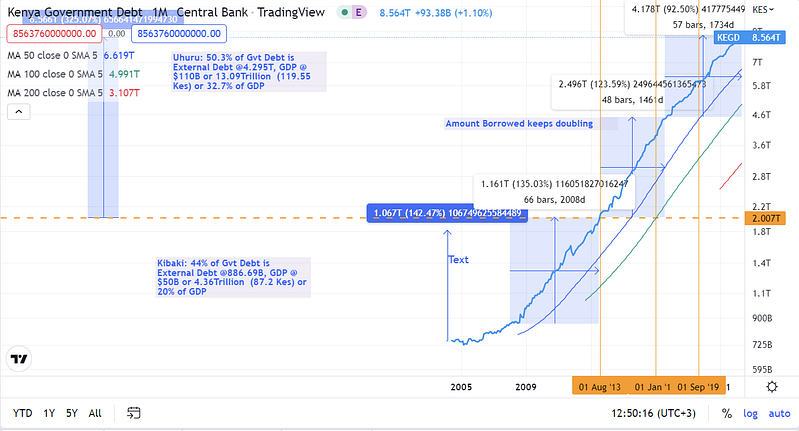
This is because, during the Kibaki regime, they borrowed locally at low rates and the other part of government financing was largely driven by tax collected. This made banks, who like lending to the government due to reduced risks, being forced to lend to business people. This created a lot of liquidity in the economy and hence brought an economical restoration and a high GDP growth rate. This led to increased profits and the performance of the business in the stock market.
The Uhuru regime became more pro-credit by borrowing locally to finance government projects at the expense of local businesses. These banks prefer to buy government bonds than lend to SMEs hence the cash shortfall. Because government bonds are less risky and more guaranteed. Which generally would affect performance in the stock market.
<aside> 💡
NB* Kenya is an employee-consumer-debt economy that in the global trade is a net importer. Credit thus becomes the main driver of GDP growth.
</aside>
Let see the evidence of above statements:
Kenya Debt
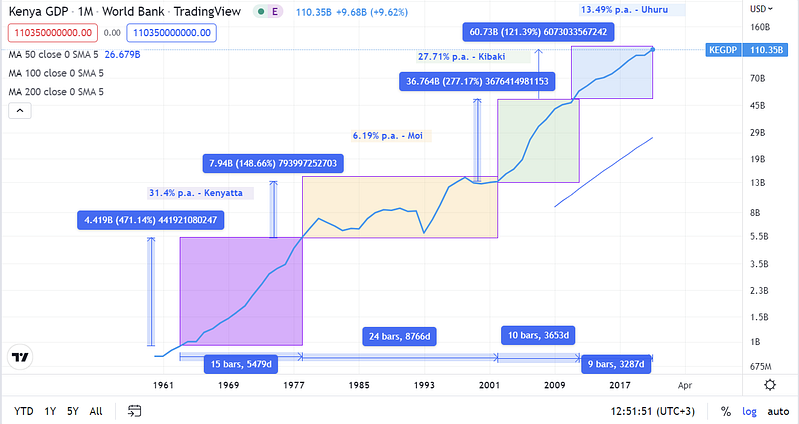
Kenya GDP growth under different presidential regimes
Kengen from 40 bob level pre-2007 to bow 5 bob level post-2020
Kengen from 40 bob level pre-2007 to bow 5 bob level post-2020
KCB from 20 level pre-2007 to 35 level post-2020.
KCB from 20 level pre-2007 to 35 level post-2020.
BOC Kenya from 150 level pre-2007 to 60 level post-2020
BOC Kenya from 150 level pre-2007 to 60 level post-2020
Industrial and manufacturing performed poorly in high-interest rate environments while banks perform remarkably well.
<aside> 💡
So as an investor:
1. It’s important to know the relation between the credit market and equity market so that if one is going down you’re well positioned for the other to go up.
2. It’s important to be doing continuous research from CREDIBLE SOURCES and develop your investment principles. Organized knowledge that is well planned into action is power.
</aside>
Investment is about decisions and the more informed you are the better you are to do due diligence and make the best decision.
Companies Elon Musk founded/heads
Now back to Elon Musk, what’s the game behind the optics of him buying Twitter?
Most like Tesla don’t have active marketing. He mainly uses Twitter to share information. Just like Steve Jobs, founder of Apple world’s most valuable company, liked to do presentations to create buzz around new products.
So Elon must be securing his means of marketing.
Just like Jeff Bezos, Amazon founder, bought Washington Post definitely to influence lobby for his vast e-commerce empire.
Information business is very big, see below.