February 24, 2025
<aside> <img src="/icons/reorder_blue.svg" alt="/icons/reorder_blue.svg" width="40px" /> Navigation
</aside>
Table Of Contents:
Take note of below new developments on taxes.
A very unfortunate move.
The Capital Markets (Amendment) Bill, 2022 intends to do the following:
The article notes the following uses of crypto:
As an investment to get good returns
Savings preservation
International remittance
Purchasing goods to import or sell
Benefits are:
Risk has been defined as price fluctuation.
Unfortunately, they seem to be copying and pasting the old centralized way of doing things to the new ecosystem. This is in terms of registration and licensing. Bill seeks to recognize crypto as securities. So if you buy and sell within a year you pay income taxes. If you sell after 1 year you pay capital gain tax. This looks like adopted from the US.
The Bill looks like it’s aimed at formalizing and taxing crypto rather than safeguarding consumers. Though I haven’t had a look at the bill, from the article, it looks like it is missing critical components such as Directors of exchange ‘fit & proper form’, risk management, governance etc similarly availed by the National Payment System regulation.
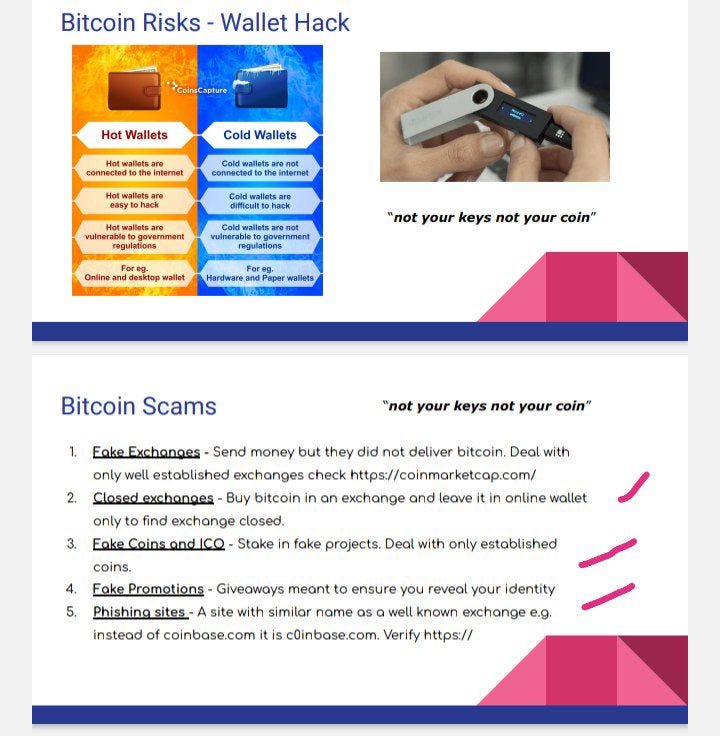
The challenge with revealing information about how much crypto you have is that crypto isn’t like money in your bank account it is like cash in your house. Bitcoin like cash or gold is a bearer asset. The bearer is considered the owner.
Now imagine, revealing how much cash or gold you have in your house or office. What do you think will happen with the rising cases of insecurity in Kenya?
There’s a very good reason why Satoshi, the founder of Bitcoin, remains anonymous. It’s part of security.
A review of recent events in 2022 shows that it’s the centralized side of things that is failing not the decentralized one.
One of the proposals of the bill states “centralised electronic register of all transactions in digital currencies.”
Now if you Google “Celsius crypto records” you will see what happens when such a record becomes public.
In banking, “KYC accounts + Private records of amount & transaction”, in crypto “Anonymous owner with Private keys + Public wallet address & Transactions “. There’s an unknown aspect in each setup by default for security. Creating a “Known wallet address owner + Public Transaction record of amount & transactions” is a big risk.
You can’t put new wine in an old wineskin, it will just burst.
The benchmark for any crypto is Bitcoin, the pioneer of blockchain. Which is a peer-to-peer network that is:
Any Crypto that requires the permission of a centralized third party has failed the test of what blockchain entails in terms of being a decentralized peer-to-peer network. If verifiability is by a third party rather than the network, then it’s based on trust and susceptible to censorship and all sorts of things a decentralized network is supposed to resolve.
My analogy: Bitcoin which as proof-of-work is encrypted electric energy can be compared to oxygen, the miners are the trees, the nodes are the lungs and the wallets are the red blood cells. Any tree that is alive can be part of the network of production of oxygen, the trees are public the lungs are private to an individual. Oxygen is decentralized, censorship-resistant, permission-less and accessible to all.
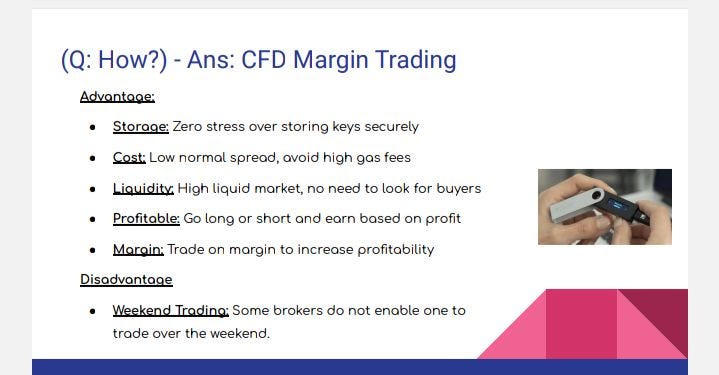
We aren’t trading crypto directly so this doesn’t apply in my opinion but we will seek clarity from legal and tax advisors when the time comes.
To join our coaching and copy trading, please click on this link.
This is more like it for those who don’t understand derivatives this document, especially section 2 has clearly defined: • call option, • currency swap, • financial derivative, • forward contract, • future contract • interest rate swap • option contract • put option • option premium • swap • underlying asset
In this case, our underlying asset is crypto, when you deal with XAUUSD it’s gold, USOIL it’s oil, EURUSD it’s Euro etc.
Now that they mention tax avoidance in section 5 let me define 2 things.
First and foremost this isn’t advisory of any kind just information sharing. Once we earn, consult an expert.
Difference between tax avoidance and tax evasion. Let me use the example of a tenant and a landlord to the best of my understanding.
<aside> 💡
</aside>
A politically correct word I see people use for tax avoidance is tax efficiency. A tenant in this case is a resident and landlord of the country. As an investor, it’s important to engage professional tax advisory services and do tax planning so that you make the best decision of where to operate from either as a person or a company.